
Draw the graphs for the following tables of values, with suitable scales on the axes.
(a) Cost of apples
|
Number of apples |
1 |
2 |
3 |
4 |
5 |
|
Cost (in ₹) |
5 |
10 |
15 |
20 |
25 |
|
Time (in hours) |
6 a.m. |
7 a.m. |
8 a.m. |
9 a.m. |
|
Distance (in km) |
40 |
80 |
120 |
160 |
(ii) What was the time when the car had covered a distance of 100 km since its start?
(c) Interest on deposits for a year:
Deposit (in ₹) |
1000 |
2000 |
3000 |
4000 |
5000 |
|
Simple interest (in ₹) |
80 |
160 |
240 |
320 |
400 |
(i) Does the graph pass through the origin?
(ii) Use the graph to find the interest on ₹ 2500 for a year:
(iii) To get an interest of ₹ 280 per year, how much money should be deposited?
Answer:
(a) Taking a suitable scale (for x-axis, 1 unit = 1 apple and for y-axis, 1 unit = ₹ 5), we can mark the number of apples on x-axis and the cost of apples on y-axis. A graph of the given data is as follows.
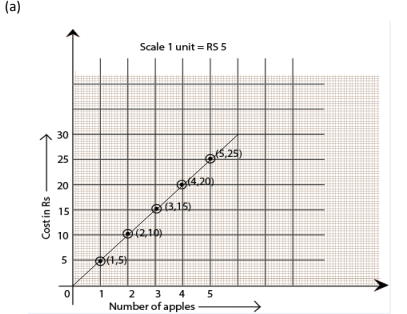
A graph of the given data is as follows.
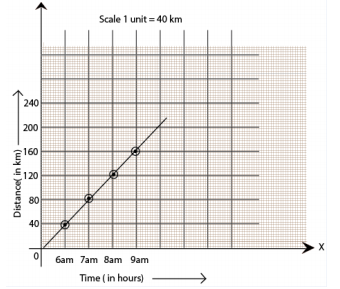
(i) During the period 7:30 a.m. to 8 a.m., the car covered a distance of 20 km.
(ii) The car covered a distance of 100 km at 7:30 a.m. since its start.
(c) Taking a suitable scale,
For x-axis, 1 unit = ₹ 1000 and for y-axis, 1 unit = ₹ 80
We can represent the deposit on x-axis and the interest earned on that deposit on y-axis.
A graph of the given data is obtained as follows.
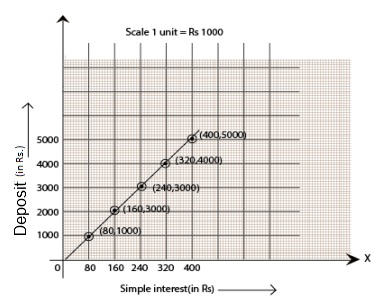
From the graph, the following points can be observed.
(i) Yes. The graph passes through the origin.
(ii) The interest earned in a year on a deposit of ₹ 2500 is ₹ 200.
(iii) To get an interest of ₹ 280 per year, ₹ 3500 should be deposited.
Question 2:Draw a graph for the following.
(i)
|
Side of square (in cm) |
2 |
3 |
3.5 |
5 |
6 |
|
Perimeter (in cm) |
8 |
12 |
14 |
20 |
24 |
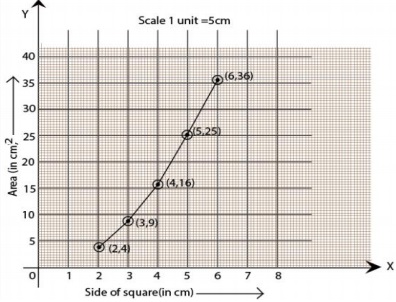
(ii)
|
Side of square (in cm) |
2 |
3 |
4 |
5 |
6 |
|
Area (in cm2) |
4 |
9 |
16 |
25 |
36 |
Answer:
(i) Choosing a suitable scale,
For x-axis, 1 unit = 1 cm and for y-axis, 1 unit = 4 cm
We can represent the side of a square on x-axis and the perimeter of that square on y-axis. A graph of the given data is drawn as follows.
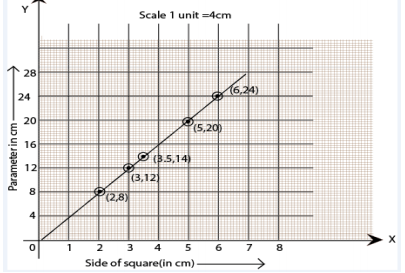
It is a linear graph.
(ii)Choosing a suitable scale,
For x-axis, 1 unit = 1 cm and for y-axis, 1 unit = 4 cm2
We can represent the side of a square on the x-axis and the area of that square on y-axis. A graph of the given data is as follows.


.png)

0 Comments